For decades, enterprise Wide Area Networking (WAN) relied on rigid, expensive, and carrier-locked private transport circuits—predominantly Multiprotocol Label Switching (MPLS) and leased T1/E1 lines. While MPLS provided guaranteed bandwidth and deterministic Quality of Service (QoS), its exorbitant cost per megabit, months-long provisioning lead times, and centralized ‘hub-and-spoke’ backhauling architecture became major bottlenecks as corporate applications migrated to distributed cloud environments (AWS, Azure, Microsoft 365). The technology that dismantled this legacy model is Software-Defined Wide Area Networking (SD-WAN).
The Architectural Decoupling: Underlay vs. Overlay Networks
Modern SD-WAN architectures operate through a strict separation between physical transport and logical routing:
- The Underlay Network: The raw, physical telecommunications infrastructure provided by commercial ISPs, telcos, and mobile carriers. The underlay encompasses physical fiber lines, 4G/5G wireless towers, cable modems, public IP routing, and BGP peering across the public Internet. The underlay provides basic point-to-point IP packet reachability between branch gateways and cloud data centers.
- The Overlay Network: A software-defined, cryptographically secured mesh of virtual IPsec (or WireGuard) tunnels established dynamically between SD-WAN edge appliances. The overlay abstracts the diverse underlay circuits into a unified, virtual transport fabric, making routing decisions based on real-time packet telemetry rather than static routing tables.
| Architectural Plane | SD-WAN Implementation | Operational Engineering Responsibility |
|---|---|---|
| Orchestration Plane | Cloud SaaS Portal / vManage / Director | Centralized single-pane-of-glass policy authoring, zero-touch provisioning, lifecycle monitoring. |
| Management Plane | REST APIs, Netconf/YANG, CLI Automation | Pushes configuration templates, security policies, and software updates to distributed edge appliances. |
| Control Plane | vSmart / Centralized OMP / BGP Controllers | Distributes routing reachability, TLOC transport mappings, and encryption keys; replaces hop-by-hop IGP. |
| Data Plane | vEdge / cEdge / Physical & Virtual Edge Gateways | Executes hardware-accelerated IPsec encryption, Deep Packet Inspection (DPI), and local packet forwarding. |
Application-Aware Routing and Real-Time Path Performance Probing
The signature capability of SD-WAN is Dynamic Application-Aware Routing (AAR). SD-WAN edge routers continuously transmit high-frequency synthetic probe packets (such as Bidirectional Forwarding Detection / BFD) across every active underlay transport path to measure three real-time telemetry metrics: Latency, Jitter, and Packet Loss.
Through Deep Packet Inspection (DPI), the edge router identifies application signatures within the first few packets of a flow. The policy engine matches the traffic against Service-Level Agreement (SLA) contracts:
- VoIP & Video (Real-Time SLA): Mandates latency $< 150 \text{ ms}$, jitter $< 30 \text{ ms}$, and packet loss $< 1\%$. If the primary broadband connection experiences brief packet loss, the router dynamically steers active voice packets to a secondary 5G link in milliseconds without dropping the phone call.
- Business Critical Cloud (SaaS SLA): Routes directly over local broadband via Direct Internet Breakout (DIA), bypassing the corporate headquarters data center to eliminate latency.
- Bulk Data & Backups: Steered to inexpensive commodity broadband or off-peak links, preserving premium bandwidth for interactive traffic.
Convergence with Secure Access Service Edge (SASE)
Because SD-WAN branches break out directly to the public Internet, traditional centralized perimeter firewalls located at corporate headquarters are bypassed. To secure branch traffic, the industry has converged SD-WAN with cloud-native security into Secure Access Service Edge (SASE), standardized by Gartner. SASE integrates SD-WAN edge routing with cloud-delivered security services: Cloud Access Security Brokers (CASB), Secure Web Gateways (SWG), Zero Trust Network Access (ZTNA), and Firewall-as-a-Service (FWaaS), ensuring uniform enterprise security policies are enforced worldwide regardless of where users connect.
IPsec Cryptographic Encapsulation, IKEv2 Key Exchanges and Forward Secrecy
The security and data integrity of an SD-WAN overlay network relies on automated, hardware-accelerated IPsec (Internet Protocol Security) encryption tunneling, standardized under IETF RFC 4301. To establish secure overlay connectivity across untrusted public commodity broadband underlays, SD-WAN edge routers negotiate cryptographic tunnels utilizing Internet Key Exchange Version 2 (IKEv2, RFC 7296) paired with Encapsulating Security Payload (ESP, RFC 4303).
The IKEv2 establishment exchange is structured in two distinct phases:
- IKE_SA_INIT (Security Association Initialization): The two SD-WAN edge peers negotiate cryptographic algorithms (cipher, hash, Diffie-Hellman group) and exchange unauthenticated Diffie-Hellman public values ($g^a \bmod p$ and $g^b \bmod p$) along with cryptographic nonces. Both peers independently derive a shared master secret ($SKEYSEED$).
- IKE_AUTH (Authentication & Tunnel Setup): The peers authenticate identities using pre-shared public key certificates (X.509 PKI) or digital signatures inside encrypted payloads. They establish the initial child Security Association (Child SA) for data plane forwarding.
Zero-Trust Network Access (ZTNA) and Micro-Segmentation in SASE
Within the Secure Access Service Edge (SASE) paradigm, traditional network perimeter security—which granted broad lateral access to an entire corporate subnet once an employee connected to a remote VPN—is completely eradicated. SASE enforces Zero-Trust Network Access (ZTNA, NIST SP 800-207). Under ZTNA, all network entities are assumed untrusted regardless of physical location. Access is granted on a per-session, per-application basis verified by identity providers (IdP) and continuous endpoint posture checks (verifying disk encryption, OS patch levels, and EDR agents). Granular micro-segmentation tags embedded in SD-WAN overlay headers prevent lateral malware propagation, isolating compromised branch devices from core enterprise assets.
Global Retail SD-WAN Outage: The MTU Fragmentation Storm and Path MTU Black Hole
A nationwide retail enterprise operating over 2,000 branch stores migrated its point-of-sale (POS) terminals, digital inventory scanners, and in-store guest Wi-Fi from expensive legacy MPLS circuits to an automated SD-WAN Overlay Network operating over dual commercial broadband Internet connections. Following initial rollout, store managers reported that while basic ICMP pings and text emails functioned, payment card credit card processing and HTTPS inventory searches were failing intermittently with spinning web browsers.
The engineering teardown revealed that the network had suffered from an IPsec MTU Encapsulation and Path MTU Discovery (PMTUD) Black Hole. Standard Ethernet carries a Maximum Transmission Unit (MTU) of 1,500 bytes. When client workstations generated standard 1,500-byte HTTPS packets (TCP MSS = 1,460 bytes) with the Don’t Fragment (DF) bit set, the SD-WAN edge router encapsulated the packet inside IPsec ESP, UDP, and SD-WAN overlay headers, expanding the total packet size by 50 to 72 bytes (reaching 1,572 bytes).
Operational Engineering Fix: TCP MSS Clamping and Tunnel MTU Sizing
The SD-WAN architects resolved the enterprise crisis by applying two universal operational configuration parameters across all 2,000 edge appliances: (1) Setting the logical tunnel interface MTU to 1,400 bytes, and (2) Enabling TCP Maximum Segment Size Clamping (TCP MSS Clamping): ip tcp adjust-mss 1360. The SD-WAN router rewrites the SYN packet’s MSS option during the initial TCP 3-way handshake, forcing endpoints to negotiate segment sizes that fit cleanly within the IPsec tunnel envelope with zero packet fragmentation and zero latency penalties.
SD-WAN High-Availability Clustering, VRRP Failover and BFD Telemetry Tuning
Deploying SD-WAN at mission-critical enterprise branch locations (such as hospital emergency centers, manufacturing plants, and regional headquarters) mandates redundant on-premises hardware gateways operating in high-availability clusters. Standard branch architectures deploy dual SD-WAN edge appliances interconnected via Virtual Router Redundancy Protocol (VRRPv3) or proprietary chassis state clustering.
To guarantee instantaneous, seamless failover during underlay transport circuit degradation, network engineers fine-tune Bidirectional Forwarding Detection (BFD) parameters across all active IPsec overlay tunnels:
# Fine-tune BFD probe timers for rapid brownout detection
bfd app-route multiplier 3
bfd app-route poll-interval 100
# Measures latency, jitter, and packet loss every 100ms; declares brownout in 300ms
If an optical fiber cut degrades primary broadband performance, the SD-WAN policy engine shifts active application flows to the secondary cellular or satellite link in under 300 milliseconds, ensuring active voice and video streams continue without human intervention.
AI-Driven AIOps WAN Self-Healing and Low-Earth Orbit (LEO) Satellite Integration
The cutting-edge evolution of Software-Defined Wide Area Networking converges on the integration of Artificial Intelligence for IT Operations (AIOps) and Low-Earth Orbit (LEO) Satellite Constellations (e.g., Starlink, OneWeb).
AIOps-enabled SD-WAN platforms continuously analyze billions of telemetry data points using unsupervised machine learning. Instead of waiting for a circuit to experience packet loss, predictive algorithms detect microsecond degradation patterns in optical fiber dispersion or cellular tower congestion hours in advance, autonomously steering critical enterprise application flows to alternative paths before user experience degrades. Furthermore, integrating LEO satellite uplinks directly into SD-WAN edge gateway pools provides ultra-low-latency (25 to 40 ms), high-bandwidth transport to remote maritime, mining, and rural facilities, delivering enterprise-grade cloud connectivity anywhere on the planet.
Integrated Infrastructure Engineering: Physical Plants, Data Center Fabrics and Software-Defined WAN
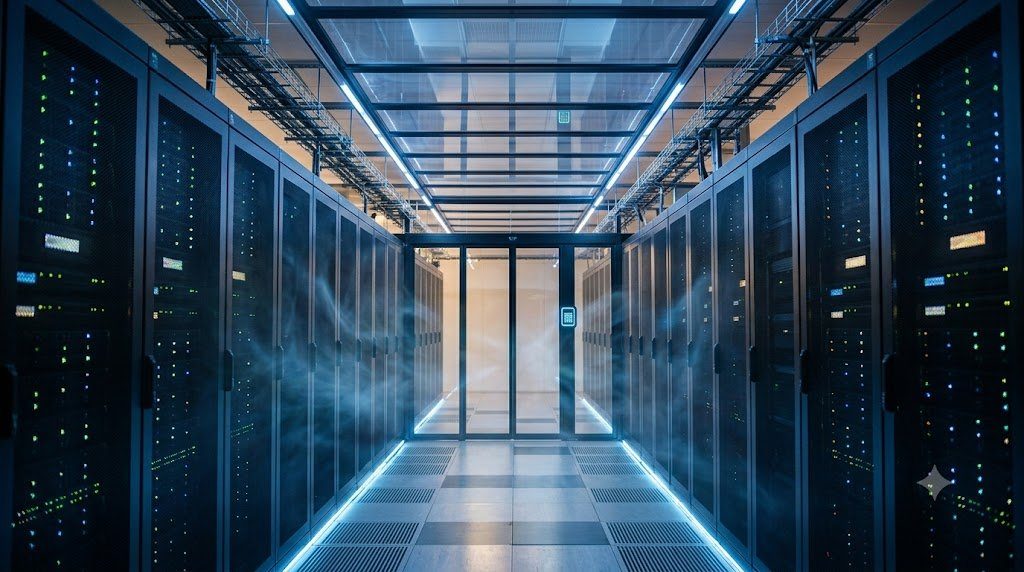
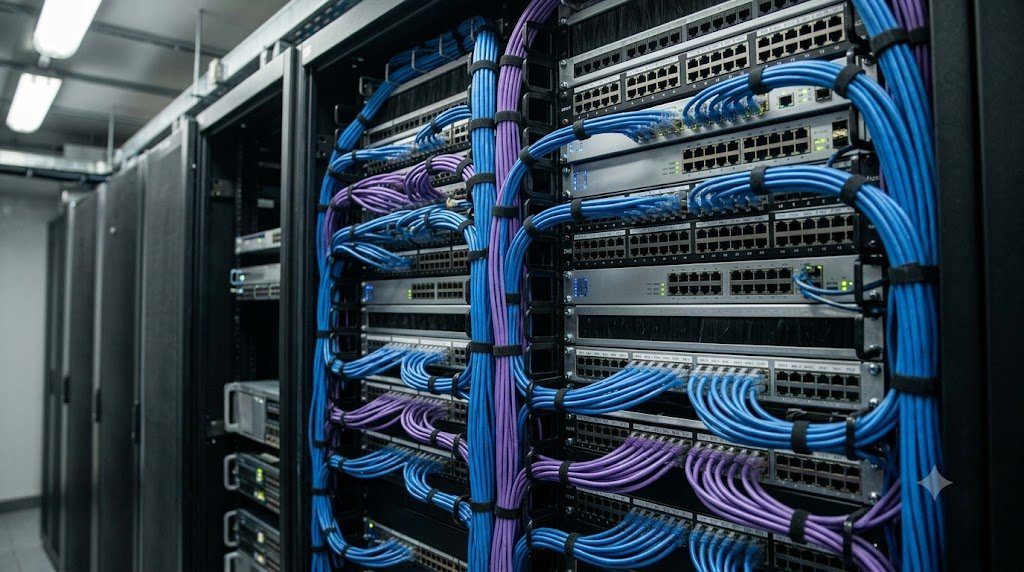
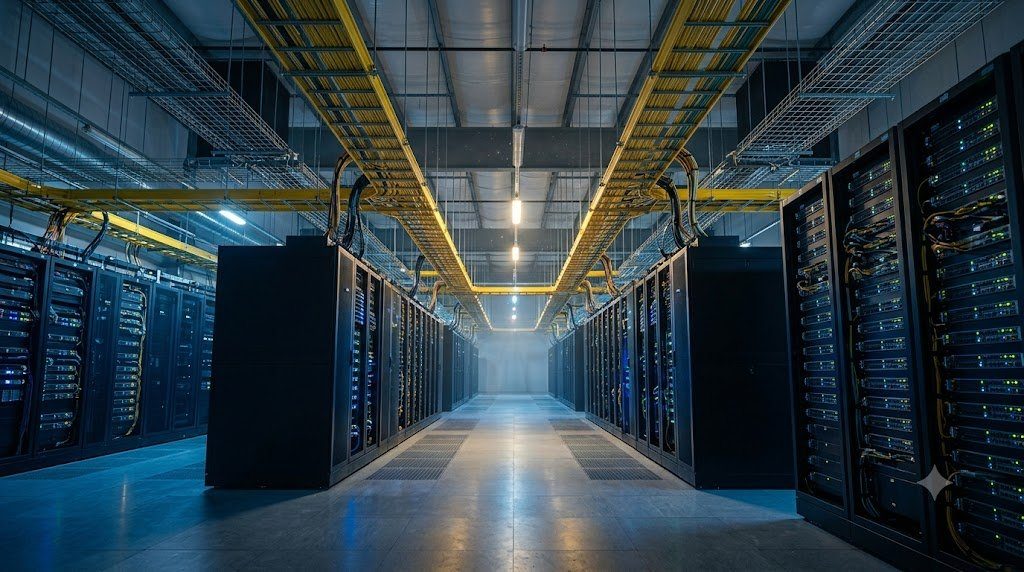
Beneath the abstract protocols, software routing daemons, and application data streams of modern telecommunications lies the physical reality of Network Infrastructure Engineering. High-performance enterprise networks, hyperscale cloud data centers, and global telecom central offices rely on the uncompromising convergence of Structured Cabling Plants, Non-Blocking Clos Topologies, Rack Thermal Fluid Dynamics, and Software-Defined Overlay Fabrics.
The operational framework of carrier-grade network infrastructure comprises four interdependent disciplines:
- Physical Plant Structured Cabling (ANSI/TIA-568): Engineering modular, standardized structured cabling subsystems across Entrance Facilities, Equipment Rooms, and Telecommunications Rooms. Managing 100-meter horizontal channel constraints, MPO/MTP multi-fiber trunk polarity (Methods A, B, C), and enforcing Tier 1 (OLTS) and Tier 2 (OTDR) field certification testing guarantees physical layer longevity across multiple active hardware lifecycles.
- Non-Blocking Data Center Clos Fabrics: Replacing legacy three-tier spanning-tree architectures with modern two-tier Spine-and-Leaf Clos networks. Leveraging Layer 3 eBGP routing (RFC 7938) and Equal-Cost Multi-Path (ECMP) delivers deterministic two-hop latency, non-blocking bisectional bandwidth, and 100% active-active link utilization optimized for intensive East-West cloud and AI cluster traffic.
- Thermodynamic Rack Thermal Management: Eliminating bypass air mixing through strict Hot Aisle / Cold Aisle containment (HAC/CAC) adhering to ASHRAE TC 9.9 guidelines. Maximizing CRAH heat exchange efficiency and deploying blanking panels slashes data center energy waste, driving Power Usage Effectiveness (PUE) down to world-class ratings beneath 1.15.
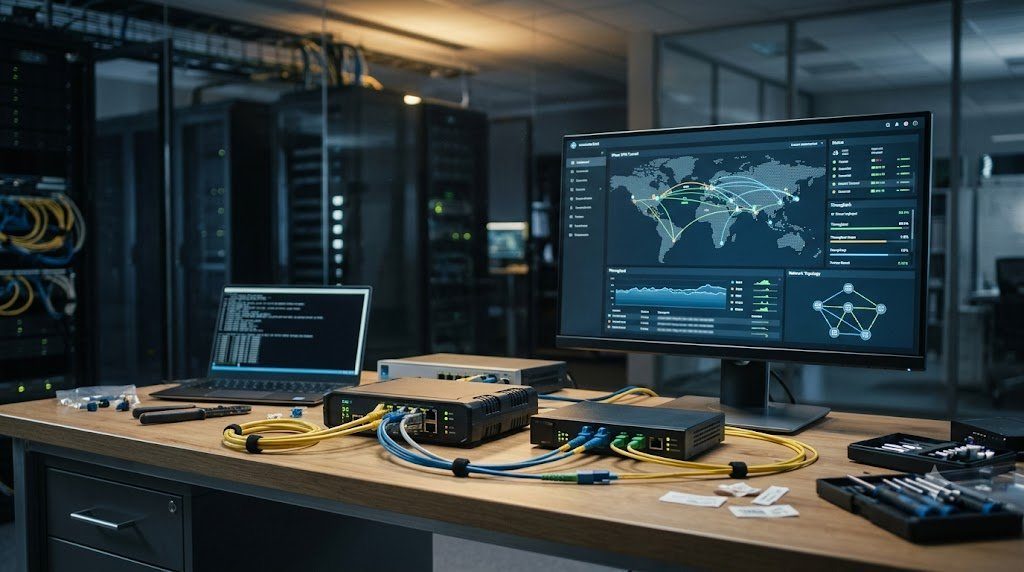
- Software-Defined WAN (SD-WAN) and SASE: Decoupling logical corporate WAN overlays from physical telecommunications underlays. Dynamic application-aware routing over encrypted IPsec tunnels provides automated circuit failover across commodity broadband and 5G, converged with cloud-native Secure Access Service Edge (SASE) security architectures to protect distributed global enterprises.
Data Center Infrastructure Management (DCIM) and Predictive Capacity Planning
Maintaining multi-megawatt mission-critical infrastructure requires 24/7/365 automated visibility through integrated Data Center Infrastructure Management (DCIM) suites. IoT sensor networks continuously sample rack intake temperatures, static pressure differentials, and electrical power branch circuit metrics. Predictive capacity planning algorithms forecast electrical draw and cooling headroom months in advance, ensuring that enterprise facilities expand compute density safely without thermal throttling or electrical circuit breaker tripping.