Software-Defined WAN (SD-WAN): Underlay vs. Overlay Networks, IPsec Tunnels and SASE Integration

For decades, enterprise Wide Area Networking (WAN) relied on rigid, expensive, and carrier-locked private transport circuits—predominantly Multiprotocol Label Switching (MPLS) and leased T1/E1 lines. While MPLS provided guaranteed bandwidth and deterministic Quality of Service (QoS), its exorbitant cost per megabit, months-long provisioning lead times, and centralized ‘hub-and-spoke’ backhauling architecture became major bottlenecks as corporate applications … Read more

Data Center Thermal Management: Hot/Cold Aisle Containment, PUE Metrics and High-Density Cooling

In modern mission-critical data center facilities, electrical power consumption and thermal heat dissipation represent the single largest operational expenditure (OpEx) and the primary physical constraint bounding compute density. Every watt of electrical power consumed by server CPUs, GPU clusters, high-speed routing ASICs, and storage arrays is converted almost entirely into Thermal Heat via resistive dissipation … Read more

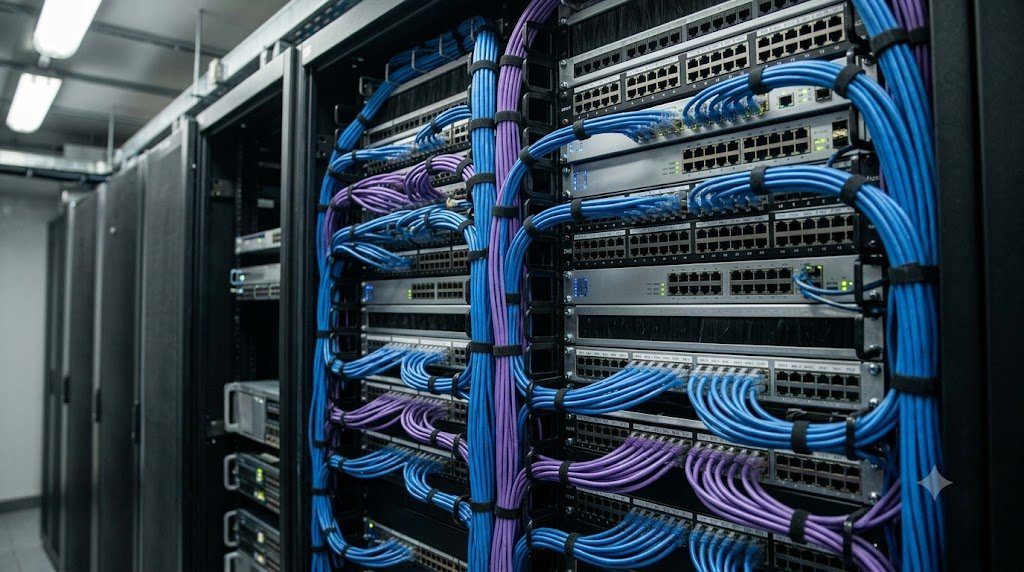
Structured Cabling Systems: ANSI/TIA-568 Standards, Patch Panel Hierarchies and MPO/MTP Fiber Trunks

Behind every high-performance enterprise data center, campus network, and telecom central office lies the physical foundation of modern communications: the Structured Cabling System (SCS). Without standardized physical cabling architecture, telecommunications facilities rapidly descend into a tangled, unmanageable ‘spaghetti’ of ad-hoc point-to-point patch cords. This disorder introduces massive cable strain, blocks cooling airflow pathways through equipment … Read more

Data Center Spine-and-Leaf Architecture: Clos Fabrics, ECMP Routing and Non-Blocking Bandwidth

In the architectural evolution of modern enterprise and cloud computing data centers, traditional multi-tier hierarchical networking models—traditionally consisting of Access, Distribution, and Core switching layers—have encountered insurmountable physical limitations. Historical three-tier topologies were engineered primarily for North-South Traffic Patterns (client requests entering from the external WAN and traveling down to web servers). However, modern distributed … Read more