Software-Defined WAN (SD-WAN): Underlay vs. Overlay Networks, IPsec Tunnels and SASE Integration
For decades, enterprise Wide Area Networking (WAN) relied on rigid, expensive, and carrier-locked private transport circuits—predominantly Multiprotocol Label Switching (MPLS) and leased T1/E1 lines. While MPLS provided guaranteed bandwidth and deterministic Quality of Service (QoS), its exorbitant cost per megabit, months-long provisioning lead times, and centralized ‘hub-and-spoke’ backhauling architecture became major bottlenecks as corporate applications … Read more
Data Center Thermal Management: Hot/Cold Aisle Containment, PUE Metrics and High-Density Cooling

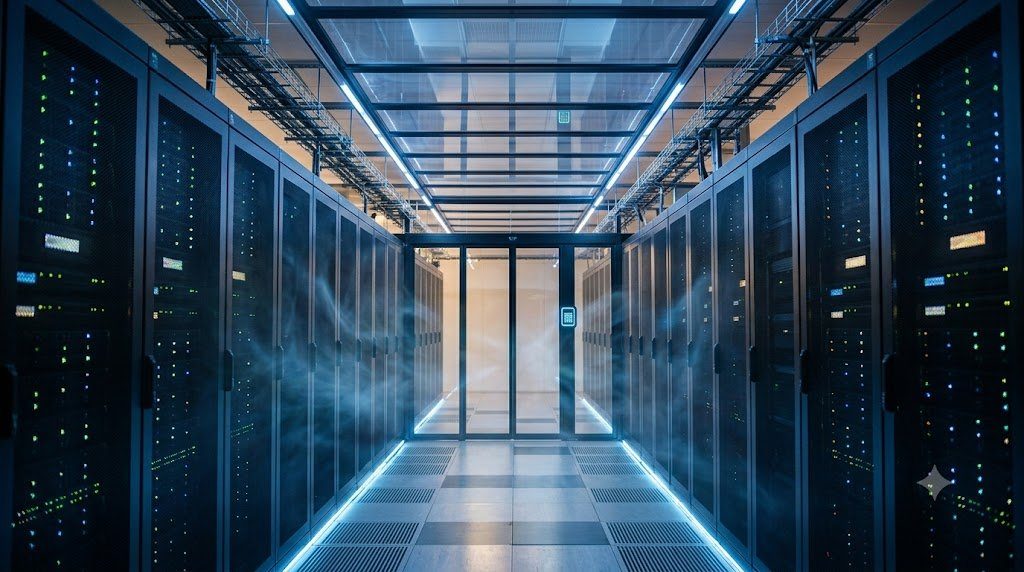
In modern mission-critical data center facilities, electrical power consumption and thermal heat dissipation represent the single largest operational expenditure (OpEx) and the primary physical constraint bounding compute density. Every watt of electrical power consumed by server CPUs, GPU clusters, high-speed routing ASICs, and storage arrays is converted almost entirely into Thermal Heat via resistive dissipation … Read more

Structured Cabling Systems: ANSI/TIA-568 Standards, Patch Panel Hierarchies and MPO/MTP Fiber Trunks

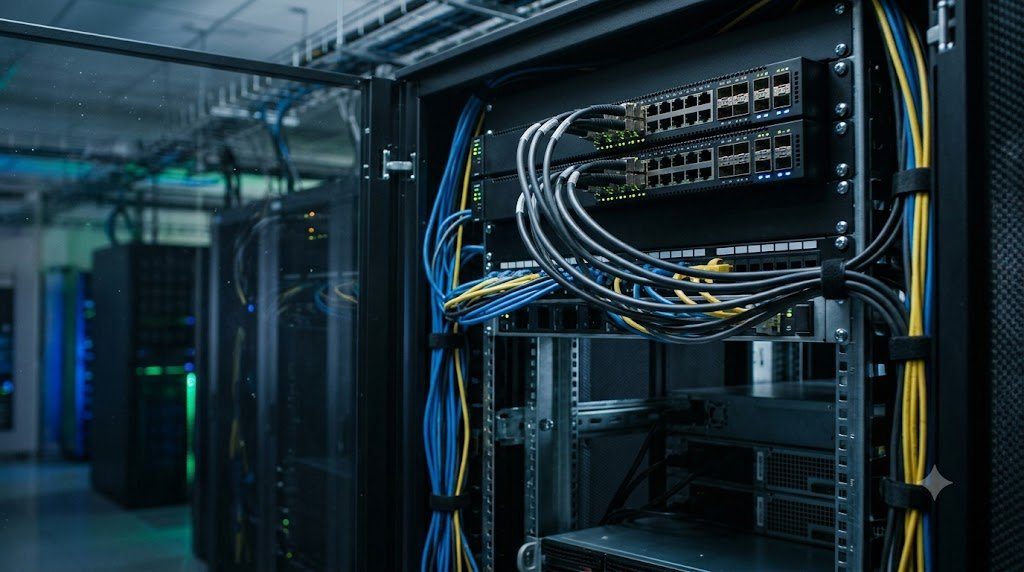
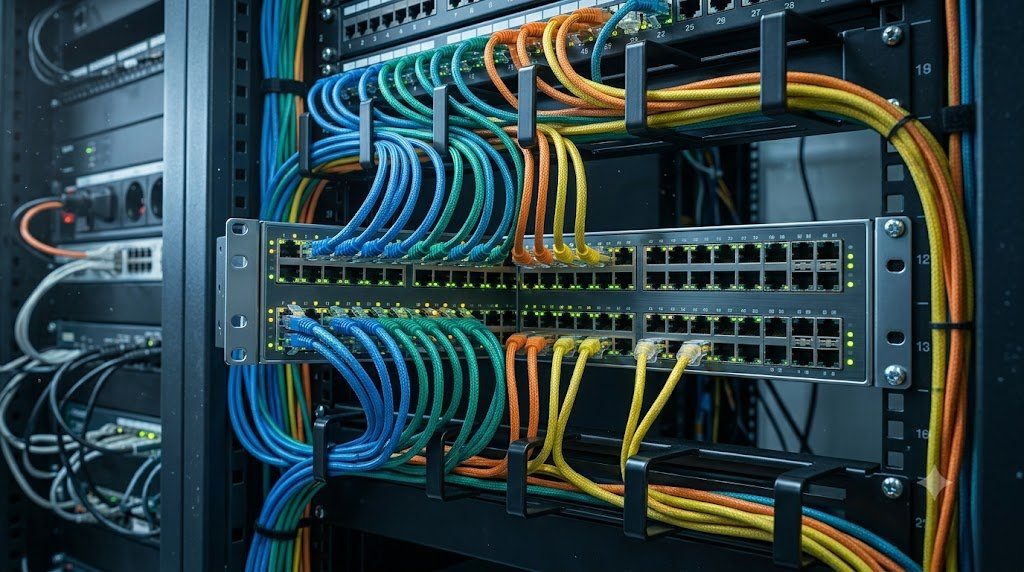
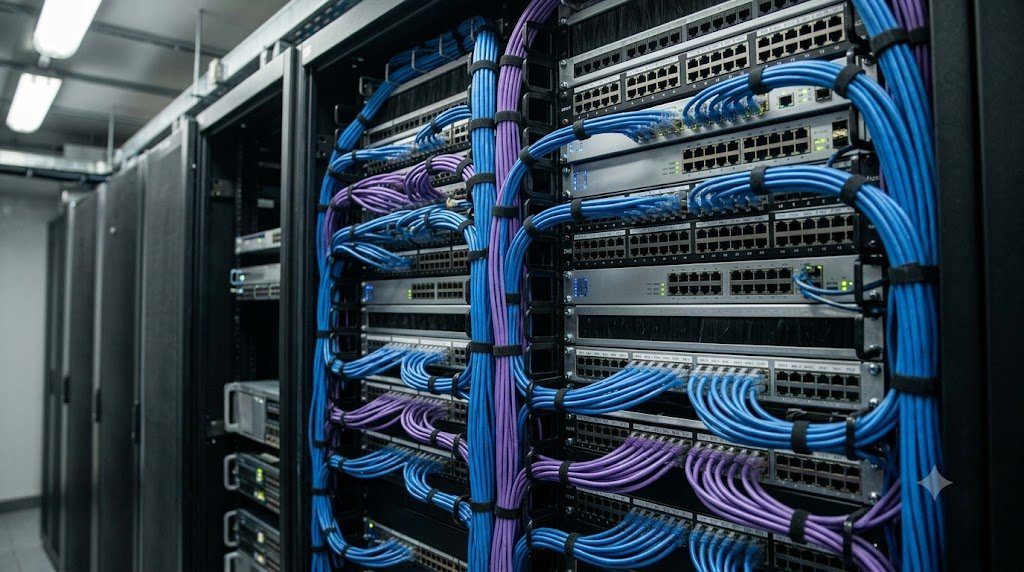
Behind every high-performance enterprise data center, campus network, and telecom central office lies the physical foundation of modern communications: the Structured Cabling System (SCS). Without standardized physical cabling architecture, telecommunications facilities rapidly descend into a tangled, unmanageable ‘spaghetti’ of ad-hoc point-to-point patch cords. This disorder introduces massive cable strain, blocks cooling airflow pathways through equipment … Read more

Data Center Spine-and-Leaf Architecture: Clos Fabrics, ECMP Routing and Non-Blocking Bandwidth

In the architectural evolution of modern enterprise and cloud computing data centers, traditional multi-tier hierarchical networking models—traditionally consisting of Access, Distribution, and Core switching layers—have encountered insurmountable physical limitations. Historical three-tier topologies were engineered primarily for North-South Traffic Patterns (client requests entering from the external WAN and traveling down to web servers). However, modern distributed … Read more

DHCP Architecture: The DORA Four-Way Handshake, Relay Agents and Option 82 Circuit Identification

In computer network administration, manually configuring static IP addresses, subnet masks, default gateways, and DNS server pointers across thousands of enterprise client endpoints is operationally unmanageable and highly prone to human addressing conflicts. The protocol that automates logical network configuration across local area networks is the Dynamic Host Configuration Protocol (DHCP), standardized under IETF RFC … Read more

Public vs. Private IP Addresses: RFC 1918 Scopes, IANA Global Registries and BOGON Filtering

In global telecommunications architecture, the Internet Protocol addressing schema is bifurcated into two mutually exclusive operational domains: Public (Globally Routable) IP Addresses and Private (Non-Routable) IP Addresses. Understanding the governance hierarchy governing global address distribution, the strict topological boundaries separating public transit from enterprise internal intranets, and the security mechanics of filtering invalid routing advertisements … Read more

IPv6 Architecture: 128-Bit Hexadecimal Structuring, SLAAC Autoconfiguration and Dual-Stack Migration

As global IPv4 free address pools reached complete exhaustion, the Internet Engineering Task Force (IETF) standardized the definitive next-generation network layer protocol: Internet Protocol Version 6 (IPv6), ratified as an Internet Standard under RFC 8200. IPv6 expands the addressing space from 32 bits to an astronomical 128 bits ($2^{128} \approx 3.4 \times 10^{38}$ unique addresses), … Read more

IPv4 Subnetting Mathematics: Binary Bitwise Logic, VLSM Architecture and CIDR Prefix Engineering

In the mathematical foundation of computer networking, Internet Protocol Version 4 (IPv4) addressing represents the foundational Layer 3 logical schema governing worldwide packet delivery. Standardized under IETF RFC 791, an IPv4 address is an exact 32-bit unsigned binary integer, commonly formatted as four 8-bit octets separated by decimal periods (Dotted Decimal Notation, e.g., 192.168.1.1). For … Read more

Link Aggregation & LACP (802.3ad): Multi-Chassis MLAG, Hashing Algorithms and Switch Stacking

In enterprise local area networks and high-density data center fabrics, individual physical Ethernet switch ports frequently encounter bandwidth saturation and single-point-of-failure vulnerabilities. A single 10 Gbps or 25 Gbps uplink connecting an access layer switch to a core distribution layer represents a rigid operational bottleneck. Rather than replacing physical hardware or installing proprietary non-standard uplinks, … Read more

Layer 2 Ethernet Switching: MAC Learning Tables, CAM Memory, 802.1Q VLAN Trunking and Broadcast Storms

In local area network engineering, Layer 2 Ethernet Switching represents the hardware foundation of high-speed data communications. Standardized under IEEE 802.3 and IEEE 802.1D, modern Ethernet switches have completely replaced legacy collision-prone hubs. By micro-segmenting local networks into dedicated, full-duplex collision domains and forwarding frames based on 48-bit Media Access Control (MAC) addresses, switching matrices … Read more

About NetGuide

About NetGuide

NetGuide is an authoritative engineering publication dedicated to computer networking, OSI model protocols, enterprise routing architecture, and data center infrastructure standards.

Learn More →
Network Engineers Cisco, Juniper & RFC-compliant guides
Hardware & Protocols In-depth BGP, OSPF, VLAN & cabling analysis
Verified Quality Empirical benchmarks & peer-reviewed data