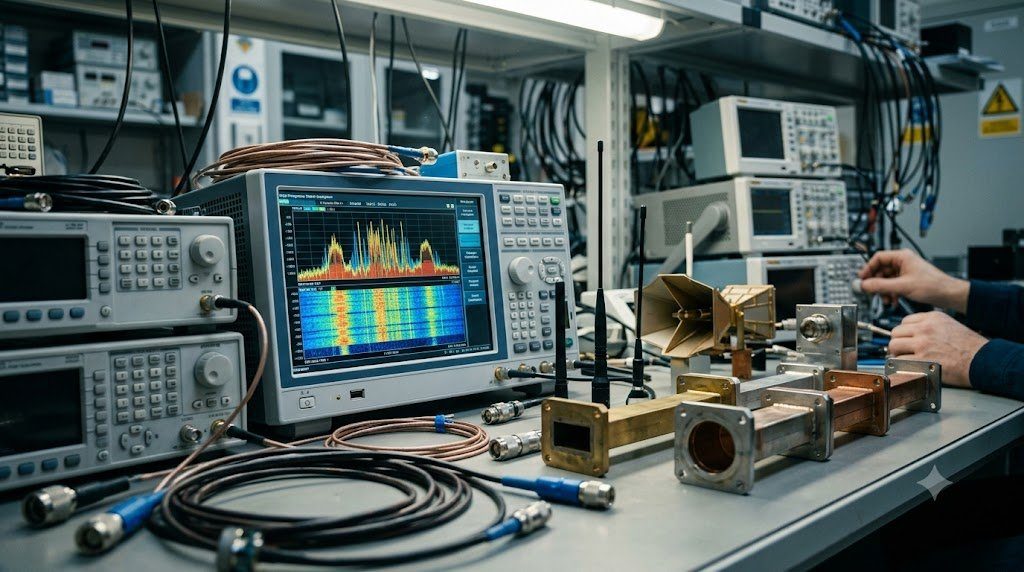



Optical Fiber Transceivers: SFP+ to QSFP-DD Form Factors, OS2 vs. OM4 and Link Budgets
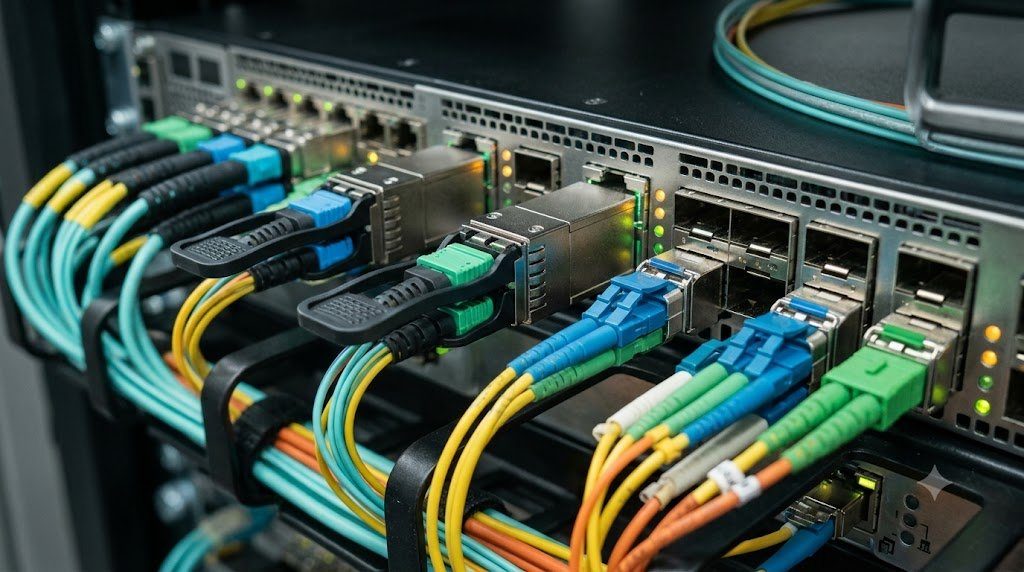
While copper twisted-pair cables dominate local horizontal workspace drops up to 100 meters, modern data center backbones, enterprise campus backbones, and inter-city telecommunications networks rely entirely on Optical Fiber Communications. Optical fiber utilizes modulated photons of infrared light guided through high-purity silica glass cores via total internal reflection, achieving near-infinite bandwidth, zero electromagnetic susceptibility, and … Read more


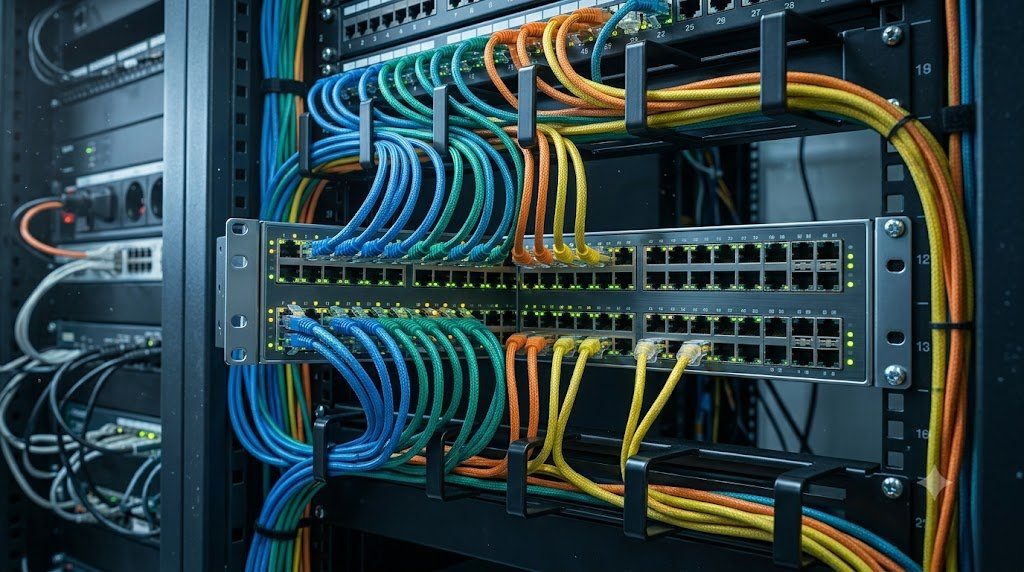
Twisted-Pair Ethernet Cabling: Cat5e to Cat8 Standards, Differential Signaling and Alien Crosstalk

In the foundational architecture of Local Area Networks (LAN), twisted-pair copper cabling remains the most ubiquitous physical transmission medium deployed worldwide. First standardized under IEEE 802.3i (10BASE-T) in 1990, balanced twisted-pair copper media has evolved through successive ANSI/TIA-568 and ISO/IEC 11801 category specifications, scaling transmission bandwidth from 10 Mbps over Category 3 telephone wire up … Read more

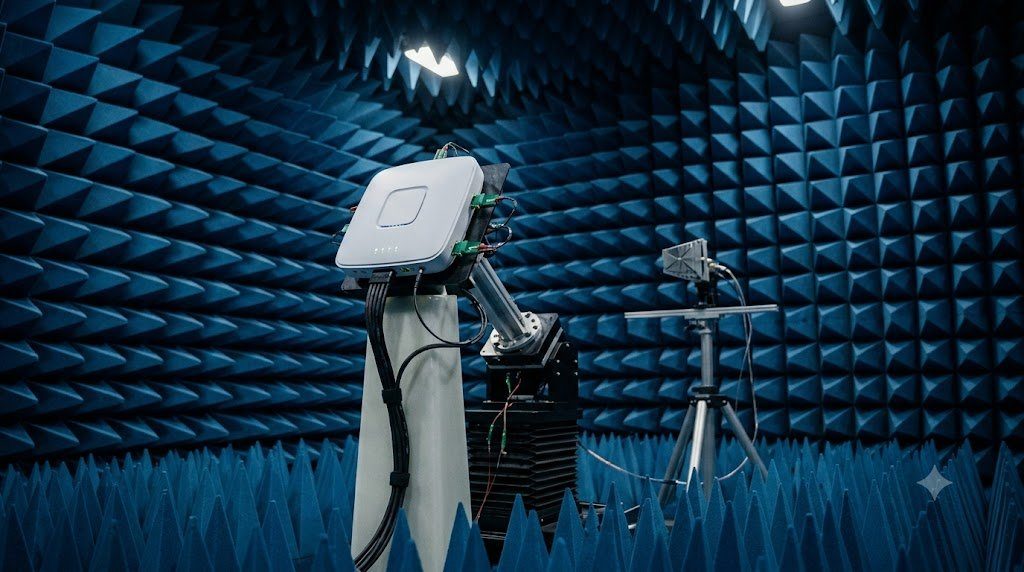
Enterprise Wi-Fi Mesh & Seamless Roaming: 802.11k/v/r Fast BSS Transitions and Dedicated Backhauls

In large-scale corporate campuses, logistics warehouses, healthcare hospitals, and sprawling residential environments, providing continuous, high-performance wireless coverage cannot be achieved with a single standalone Access Point. Deploying multiple distributed Access Points introduces two fundamental engineering challenges: establishing high-bandwidth, resilient interconnection between nodes (Mesh Backhaul Architecture), and ensuring client mobile devices transition seamlessly between adjacent radio … Read more

MU-MIMO and Explicit Beamforming: Channel Sounding Matrices, CSI Feedback and Spatial Streams

In terrestrial wireless radio communications, the physical broadcast medium is unconstrained space. Electromagnetic waves radiated from an omni-directional antenna propagate outward in all directions, losing power according to the inverse-square law and reflecting off walls, floors, and metal furniture. Historically, these multipath reflections caused severe destructive phase interference (Rayleigh fading). Modern high-performance Wi-Fi fundamentally transforms … Read more

OFDMA vs. OFDM in Wi-Fi: Subcarrier Spacing, Resource Unit (RU) Allocation and Deterministic Latency

The transition from legacy Wi-Fi 5 (802.11ac) to modern Wi-Fi 6 (802.11ax) and Wi-Fi 7 (802.11be) represents the most significant physical-layer (PHY) architectural redesign in the history of the IEEE 802.11 wireless standard. For two decades, wireless data transmission relied on Orthogonal Frequency-Division Multiplexing (OFDM). While OFDM enabled high throughput for individual clients, its time-division … Read more

Wi-Fi Standards Evolution: IEEE 802.11ax (Wi-Fi 6/6E), 802.11be (Wi-Fi 7) and 320 MHz Channelization

In the physical science of wireless telecommunications, Local Area Network (WLAN) connectivity is governed by the IEEE 802.11 family of specifications. Over three decades of radio frequency (RF) engineering evolution, wireless networks have transitioned from primitive, uncoordinated frequency-hopping spread-spectrum links operating at 2 Mbps into multi-gigabit, deterministic wireless switching mediums capable of rivaling wired Ethernet … Read more

Network Address Translation (NAT): PAT Port Exhaustion, CGNAT Mechanics and ICE/STUN Traversal

When the original IPv4 protocol specification (IETF RFC 791) was published in September 1981, its 32-bit addressing architecture provided an address space of approximately 4.29 billion ($2^{32}$) theoretical addresses. At the dawn of the commercial Internet, this address pool was deemed inexhaustible. However, the explosive proliferation of personal computing, enterprise local area networks, mobile smartphones, … Read more

OSPF Routing Architecture: Link-State Mechanics, Dijkstra SPF Algorithm and Multi-Area Hierarchy

Within enterprise campus networks, corporate wide-area backbones, and private cloud data centers, internal routing efficiency is governed by Interior Gateway Protocols (IGP). Standardized under IETF RFC 2328 (OSPFv2 for IPv4) and RFC 5340 (OSPFv3 for IPv6), Open Shortest Path First (OSPF) is an open-standard, classless Link-State Routing Protocol engineered for rapid convergence, hierarchical scalability, and … Read more

Border Gateway Protocol (BGP-4): Autonomous Systems, Path Vector Mechanics and Policy Routing

The global Internet functions as a federation of tens of thousands of independently administered network domains known as Autonomous Systems (AS). An Autonomous System represents a coherent collection of IP routing prefixes operating under a unified technical administration and a common internal routing policy. The foundational routing protocol that binds these disparate global networks into … Read more

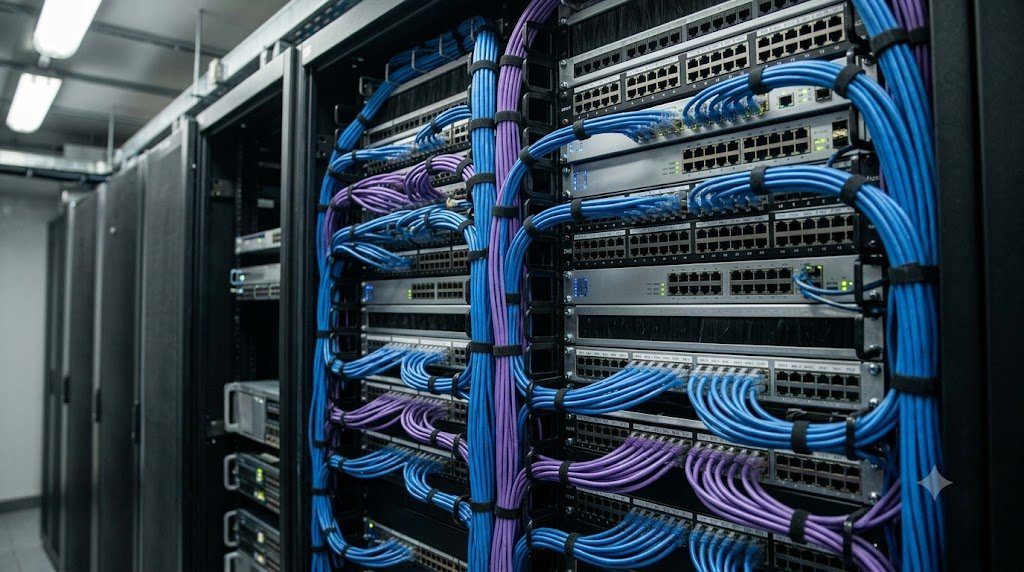
Enterprise Router Architecture: Control Plane Separation, Packet Forwarding ASICs and TCAM Lookup Engines

In modern computer network engineering, enterprise and service provider routers represent complex, high-throughput multiprocessing systems designed to determine the optimal mathematical path for packet traversal across distributed internetworks and execute line-rate packet forwarding. The foundational architectural principle governing all high-performance routing systems—spanning core backbone chassis, enterprise WAN edge gateways, and cloud data center interconnects—is the … Read more

About NetGuide

About NetGuide

NetGuide is an authoritative engineering publication dedicated to computer networking, OSI model protocols, enterprise routing architecture, and data center infrastructure standards.

Learn More →
Network Engineers Cisco, Juniper & RFC-compliant guides
Hardware & Protocols In-depth BGP, OSPF, VLAN & cabling analysis
Verified Quality Empirical benchmarks & peer-reviewed data