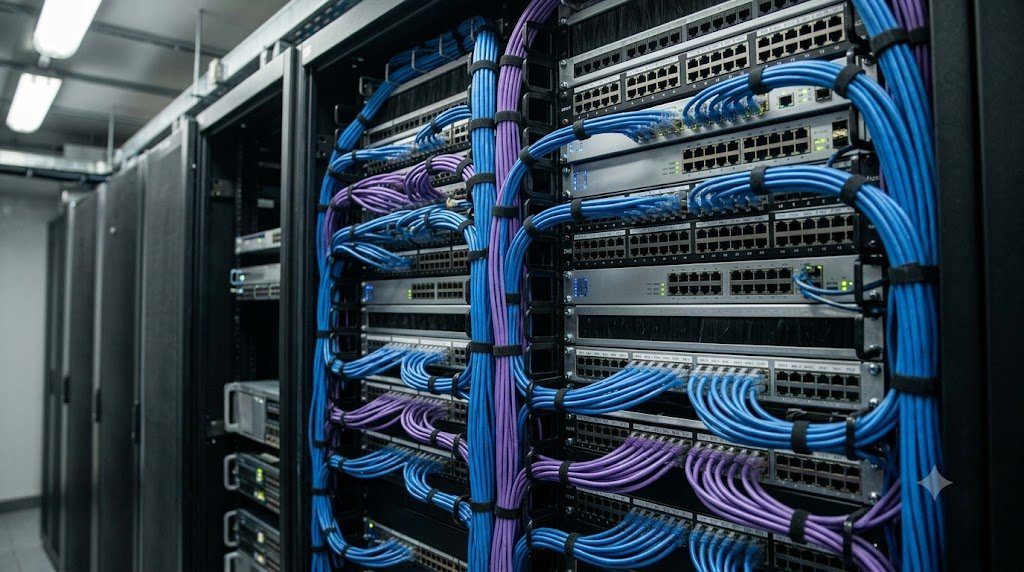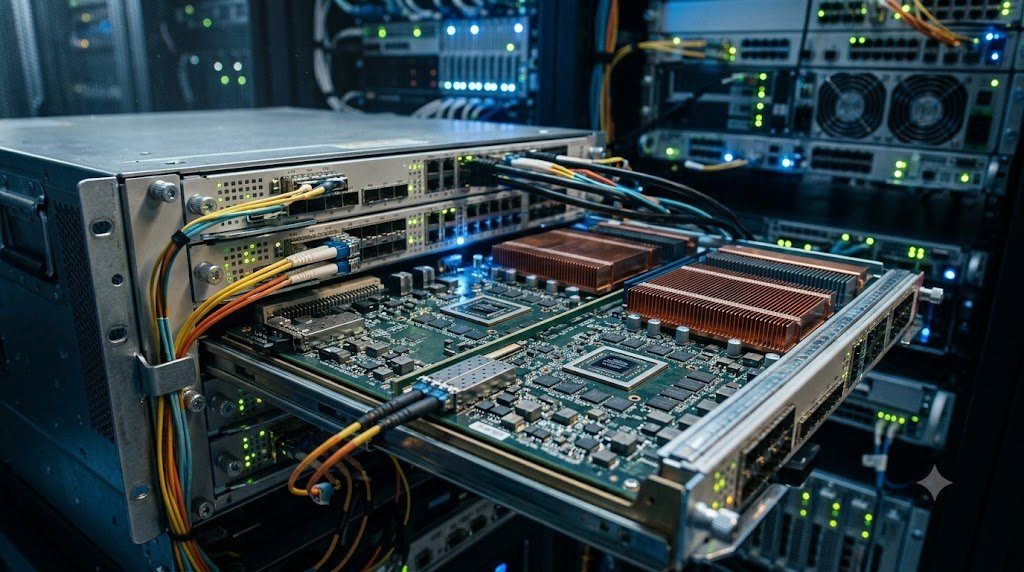
In modern computer network engineering, enterprise and service provider routers represent complex, high-throughput multiprocessing systems designed to determine the optimal mathematical path for packet traversal across distributed internetworks and execute line-rate packet forwarding. The foundational architectural principle governing all high-performance routing systems—spanning core backbone chassis, enterprise WAN edge gateways, and cloud data center interconnects—is the absolute physical and logical decoupling of the Control Plane and the Data Plane (Forwarding Plane).
Control Plane Operations: RIB Construction and Algorithmic Path Selection
The control plane executes on general-purpose microprocessors (multi-core x86 or ARM architectures). Its primary mission is the continuous maintenance of network reachability state. When a router boots and establishes peerings with adjacent nodes, routing protocol daemons exchange Link-State Advertisements (LSAs) in OSPF or Path Attributes in BGP. The control plane evaluates these topology graphs:
- Dijkstra’s Shortest Path First (SPF) Calculation: OSPF and IS-IS execute graph-theoretical algorithms to calculate loop-free shortest paths to every destination subnet based on link interface metrics.
- BGP Best Path Selection: BGP-4 executes a deterministic 13-step path attribute comparison (Weight, Local Preference, Locally Originated, AS-Path Length, Origin Type, MED, eBGP over iBGP, IGP Metric to Next-Hop, Router ID).
The aggregated results are synthesized into the Routing Information Base (RIB). The RIB contains the complete, uncompressed database of all learned routes, backup paths, and protocol metadata. However, because the RIB is structured as a complex tree within standard DRAM, querying the RIB sequentially for every arriving packet would introduce unacceptable microsecond latencies and cause packet queues to overflow under gigabit traffic streams.
Forwarding Plane Engineering: Hardware ASICs and TCAM Lookup Dynamics
To achieve wire-rate forwarding (e.g., 100 Gbps to 800 Gbps per line card), the router compiles the RIB into an optimized, pre-resolved lookup table known as the Forwarding Information Base (FIB). The FIB is pushed directly into high-speed line card hardware memory. In modern architectures (such as Cisco Express Forwarding / CEF or Juniper Packet Forwarding Engines), the FIB resolves all recursive next-hop IP addresses directly to physical egress interfaces and pre-computed Layer 2 rewrite MAC headers.
The physical engine executing line-rate IP prefix matching is Ternary Content-Addressable Memory (TCAM). Unlike conventional RAM which takes a memory address and outputs data, CAM takes a data search key and returns the matched address in a single clock cycle. Standard binary CAM evaluates only binary values ($0$ and $1$). In contrast, TCAM introduces a third logical state: ‘Don’t Care’ (Masked / Wildcard bit: X):
| TCAM Entry Pattern | Bitmask Representation | Prefix Length (CIDR) | Associated Forwarding Action |
|---|---|---|---|
| 192.168.1.0 | 255.255.255.0 (/24) | 24-bit Exact Match | Forward to Egress Port Eth1/1, Rewrite MAC 00:1A:2B:3C:4D:5E |
| 192.168.0.0 | 255.255.0.0 (/16) | 16-bit Aggregation Match | Forward to Egress Port Eth1/2, Rewrite MAC 00:1A:2B:3C:4D:5F |
| 10.0.0.0 | 255.0.0.0 (/8) | 8-bit Supernet Match | Forward to Egress Port Eth2/1, MPLS Push Label 16048 |
| 0.0.0.0 | 0.0.0.0 (/0) | 0-bit Default Route | Forward to WAN Transit Interface Eth3/1, Decrement TTL |
Because TCAM searches all table entries in parallel during a single clock cycle ($< 5 \text{ ns}$), it inherently implements Longest Prefix Match (LPM) by arranging prefix rules in descending order of prefix length. If an incoming packet arrives with destination IP 192.168.1.150, both the /24 and /16 entries match; however, the hardware priority encoder instantly selects the more specific /24 entry.
Distributed Switching Fabrics: Crossbar Fabrics vs. Shared Bus Memory
In entry-level branch routers, packets traverse a centralized shared memory bus where the main CPU or a single forwarding engine processes all ingress and egress ports. However, in enterprise chassis routers, internal backplanes utilize Crossbar Switching Fabrics. A crossbar fabric consists of an orthogonal matrix of input and output data lines intersecting at electronic crosspoint switches.
When line card A receives a packet destined for line card C, the ingress fabric scheduler negotiates a non-blocking path across the crossbar matrix. Modern architectures employ Virtual Output Queuing (VOQ) at ingress ports to eliminate Head-of-Line (HoL) blocking—a condition where a packet destined for a congested egress port blocks unrelated packets behind it in the queue from reaching available, uncongested ports.
Control Plane Policing (CoPP) and Security Gateways
Because the control plane processor possesses finite computational bandwidth, it represents a primary vector for distributed denial-of-service (DDoS) exploitation. If an attacker floods the router with millions of spoofed IP packets destined for the router’s own loopback address, or transmits packets with expiring TTLs ($TTL = 1$) forcing ICMP Time Exceeded generation, the router’s CPU would become overwhelmed generating exception packets, causing routing protocol keepalives to drop.
To protect against CPU starvation, network architects enforce Control Plane Policing (CoPP). CoPP leverages hardware rate-limiters inside the data plane ASICs to classify and filter traffic heading toward the control plane CPU. Legitimate routing protocol traffic (BGP TCP port 179, OSPF IP protocol 89) is granted dedicated, guaranteed bandwidth policers, while ICMP generation, ARP requests, and SSH management sessions are strictly rate-limited, ensuring the router maintains stable protocol peerings even during severe network transit saturation.
Silicon Packet Forwarding Pipelines and Input/Output Queuing Dynamics
To understand how a modern high-performance routing ASIC achieves wire-rate line throughput exceeding multiple terabits per second, network systems engineers trace packets through the silicon-level pipeline stages. Inside a modern network processor (such as Cisco Silicon One, Broadcom Jericho2, or Juniper Express), the packet forwarding path is structured as a hardware pipeline executing discrete, deterministic processing stages across sequential clock cycles: Parser, Ingress Security/ACL Evaluation, Ingress Forwarding Lookup (LPM), Traffic Manager Queuing, Egress Security/Rewrite, and Egress Media Access Control.
When an optical transceiver presents serialized bitstreams to the Physical Coding Sublayer (PCS), the framing logic delineates Ethernet boundaries and passes frames to the Hardware Parser. The parser decodes multi-layer protocol headers—stripping Layer 2 VLAN tags, Layer 3 IPv4/IPv6 headers, and Layer 4 TCP/UDP ports—extracting key search fields into a standardized Packet Header Vector (PHV). While the packet payload is stored directly in high-bandwidth on-chip SRAM memory buffers (or external High Bandwidth Memory / HBM), only the lightweight PHV traverses the silicon processing stages, eliminating memory bandwidth bottlenecks.
Virtual Output Queuing (VOQ) Mathematical Proof of Non-Blocking Fabrics
In crossbar switching backplanes, standard input queuing suffers from Head-of-Line (HoL) blocking, which mathematically limits theoretical maximum fabric throughput to approximately 58.6% (1 – 1/e) under uniform traffic distributions. Modern enterprise routing chassis eliminate this barrier through Virtual Output Queuing (VOQ). At each ingress line card port, separate logical queues are maintained for every physical egress port in the entire chassis ($VOQ_{i,j}$, where $i$ is ingress port and $j$ is egress port). A centralized hardware arbiter executes maximal bipartite matching algorithms (such as iSLIP or parallel iterative matching), scheduling conflict-free cell transfers across the crossbar matrix and achieving 100% throughput without queue congestion.
Operational Post-Mortem: The 512k TCAM Global Internet Routing Table Crisis
On August 12, 2014, a major operational crisis rippled across the global Internet infrastructure, widely documented by telecommunications engineers as the ‘512k Day’ Outage. Tens of thousands of enterprise and service provider border routers worldwide (most notably legacy Cisco Catalyst 6500 chassis and 7600 series routers powered by Supervisor 720 / PFC3 line cards) experienced sudden, uncommanded memory exhaustion, CPU spikes reaching 100%, and massive packet dropping.
The root cause was the physical storage limit of hardware Ternary Content-Addressable Memory (TCAM). Under default factory configurations, these older forwarding engines allocated exactly 512,000 (512k / 524,288) entries in their hardware TCAM partitions to store the global IPv4 Forwarding Information Base (FIB). For over a decade, this allocation was sufficient. However, as global IP prefix de-aggregation accelerated, Verizon’s autonomous system (AS 701) announced several thousand new sub-prefixes on August 12, pushing the global IPv4 BGP routing table count beyond 512,000 routes for the first time in history.
Engineering Countermeasures and TCAM Slicing Re-Profiles
The emergency operational mitigation required network engineers to issue emergency SDM (Switching Database Manager) template modifications (e.g., mls cef maximum-routes ip-multicast 0 or re-allocating IPv6 TCAM space to expand IPv4 capacity to 1,000,000 routes) and reboot core chassis. The incident permanently transformed routing ASIC design: modern enterprise and core routing platforms deploy dynamic TCAM virtualization and expandable High Bandwidth Memory (HBM) capable of holding upwards of 4,000,000 to 10,000,000 routes, isolating hardware forwarding from global table growth.
Operational CLI Diagnostics and Hardware TCAM Utilization Monitoring
To guarantee high-availability carrier-grade operations, network systems administrators and NOC engineers must continuously monitor hardware forwarding table utilization across enterprise chassis routers. In platforms running Cisco IOS-XE, NX-OS, or Juniper Junos OS, memory utilization commands provide granular visibility into TCAM allocation, hardware forwarding table exhaustion risks, and punt-path CPU queue health.
Engineers utilize standardized CLI diagnostic sequences to verify hardware FIB consistency:
# Verify hardware TCAM table utilization on enterprise chassis
Router# show platform hardware qfp active tcam resource-manager usage
Router# show platform hardware qfp active infrastructure bqs queue output default
# Inspect punt-path packet queues heading toward control plane CPU
Router# show platform software status control-plane
Router# show platform hardware qfp active statistics drop
If hardware drop statistics indicate non-zero increments on DropTCAMFull or TailDropPuntQueue, immediate architectural remediation is required: either tuning prefix aggregation or migrating edge peers to dedicated hardware line cards.
Emerging Horizons: Programmable Data Planes via P4 and 51.2 Tbps Switching Silicon
The traditional model of fixed-function routing ASICs—where protocol parsing, packet lookup, and header rewrites are hardcoded permanently into silicon wafers during manufacturing—is undergoing a profound transformation. Network systems architects are rapidly embracing P4-Programmable Data Planes and software-defined forwarding silicon (such as Intel Tofino and Cisco Silicon One architectures).
Using the domain-specific P4 Programming Language (Programming Protocol-Independent Packet Processors), network engineers can define custom packet parsers, novel encapsulation headers, and telemetry metadata pipelines in software, compiling them directly onto wire-rate hardware ASICs without waiting years for silicon chip respins. Furthermore, forwarding silicon bandwidth is scaling to unprecedented levels: modern single-chip networking processors achieve an astonishing 51.2 Terabits per second (Tbps) switching throughput, capable of servicing 64 ports of 800 Gbps Ethernet on a single silicon die, paving the way for next-generation multi-terabit edge routers.
Integrated Routing Architecture: Control Plane Resilience and Line-Rate Silicon Synthesis
In modern enterprise telecommunications engineering, deploying resilient, scalable routing infrastructure requires the seamless physical and logical integration of Control Plane Intelligence, Silicon Forwarding ASICs, Dynamic Path Selection, and Edge Border Security. Modern routing systems function as the foundational circulatory system of global digital communications, transforming mathematical graph theory and network policy contracts into nanosecond packet forwarding decisions.
The operational framework of enterprise routing architecture is governed by four primary engineering tenets:
- Control and Data Plane Independence: Isolating cognitive path-selection algorithms (BGP-4, OSPFv3, IS-IS) running in general-purpose control memory from hardware-accelerated forwarding engines (FIB, TCAM, crossbar fabrics). This ensures that heavy control plane recalculations during global route flapping events never degrade line-rate customer forwarding throughput.
- Deterministic Algorithmic Convergence: Engineering sub-50-millisecond network failover using hardware Bidirectional Forwarding Detection (BFD) paired with Loop-Free Alternate (LFA) Fast Reroute and BGP Prefix Independent Convergence (BGP PIC), eliminating human intervention during fiber severed incidents.
- Policy-Driven Traffic Engineering: Leveraging BGP Communities, Route-Reflectors, and Segment Routing to steer traffic across multi-homed ISP transits, enforcing business cost optimization and low-latency cloud interconnection.
- Hardware Edge Hardening: Enforcing Control Plane Policing (CoPP), RPKI Route Origin Validation, Unicast Reverse Path Forwarding (uRPF), and Bogon filtering to protect router infrastructure against volumetric DDoS reflection attacks and unauthorized prefix hijacking.
Continuous Telemetry, Automated NetFlow and Enterprise SLA Verification
Maintaining enterprise routing health requires continuous, granular network visibility. Modern routing platforms deploy hardware-accelerated IPFIX / NetFlow v9 Export paired with streaming telemetry (gNMI/gRPC). Forwarding ASICs sample packet flows at wire rate, streaming telemetry records to centralized time-series analytical platforms. Network operations centers (NOC) continuously audit transit latency, jitter, packet drop ratios, and BGP session health, verifying strict compliance with corporate Service-Level Agreements (SLAs) across global telecommunications backbones.